

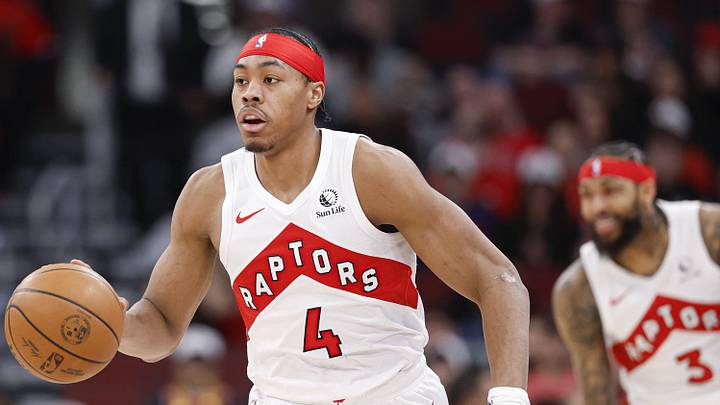
Led by Scottie Barnes and his unreal versatility, the Raptors finished the regular season with a top-five defensive rating. That defensive identity is a great foundation for a team hoping to compete relatively soon, but the Raptors still have a ton of work to do on the offensive end. After all, all of the best teams in the NBA are two-way teams.
Four teams remain in the chase for the 2026 NBA Championship: The Oklahoma City Thunder, the San Antonio Spurs, the New York Knicks, and the Cleveland Cavaliers. The Cavs are the only team in that group that didn’t finish the regular season at least top-seven in both offensive and defensive rating.
The Raptors need to improve offensively if they want to compete. They already have a star in the frontcourt, who proved in the playoffs that he could take his scoring to another level. However, the most striking difference between the Raptors and some of the best young two-way teams is the strength of their guard play.
The Raptors don’t have a star guard
The top five defenses in the regular season were the Thunder, Pistons, Spurs, Celtics, and Raptors. The first three have young cores, but they are a few steps ahead of the Raptors—miles ahead, really, when it comes to the Thunder and Spurs—because of a few differences. Not only do the Thunder, Pistons, and Spurs all have MVP candidates—Shai Gilgeous-Alexander took home the award, and Cade Cunningham and Victor Wembanyama both received votes—but they also all have star-level guards.
Gilgeous-Alexander averaged 31.1 points and 6.6 assists per game in the regular season and is still producing at a very similar level in the playoffs. Cunnigham’s regular season was impacted by a collapsed lung, and the Pistons’ offense is far from perfect, but his stardom is undeniable. He averaged 28.1 points and 7.5 assists over 14 playoff games. The Spurs may not have an MVP-level guard, but they have De’Aaron Fox, who was an All-Star this season, and Stephon Castle and Dylan Harper, who already look like future superstars.
Immanuel Quickley has been good for the Raptors. His playmaking, 3-point shooting, and speed boost a challenged offense whenever he is available, and Jamal Shead stepped up big in the playoffs. Still, the Raptors can’t compete with the star power these other teams have on the perimeter.
Pairing a star guard with a star big just makes sense and often leads to success. The Nuggets won a title with a team built around Jamal Murray and Nikola Jokic, the Thunder cruised to a championship behind strong play from Gilgeous-Alexander, Jalen Williams, and Chet Holmgren, and the Spurs are thriving with Victor Wembanyama and their array of guards next to him.
The Raptors could try to follow that formula and chase a star guard to pair with Scottie Barnes and take the offense to the next level or go all-in on size and defense at the forward spots.
 Add us as a preferred source on Google