

Just about two months after their first-round exit, the Raptors’ roster already looks much different. They traded Brandon Ingram and Gradey Dick for Kawhi Leonard; they drafted Allen Graves in the first round; Sandro Mamukelashvili chose Los Angeles in free agency; and Kyle Anderson is headed to Toronto on a one-year deal.
Trading for Kawhi Leonard helps with a lot of the Raptors’ offensive issues, as it gives them an All-NBA-level go-to scorer. But the moves they’ve made so far also still leave them with a lack of 3-point shooting.
With Ingram and Mamukelashvili headed out, the Raptors lost two of their four most efficient 3-point shooters. Leonard, who shot 38.7% on 6.8 attempts from deep this past season, can easily replace Ingram’s production. Anderson, however, isn’t much of a 3-point shooter, and while Graves shot a good percentage on a low volume in college, he is utterly unproven at the NBA level.
Unless the Raptors make another meaningful addition—which will be difficult considering the financial limitations—or someone like Jamison Battle or Alijah Martin can take a leap forward and play steady minutes, there will be a lot of pressure on Immanuel Quickley and Ja’Kobe Walter to provide floor spacing outside of Kawhi Leonard.
Quickley and Walter have to space the floor on offense
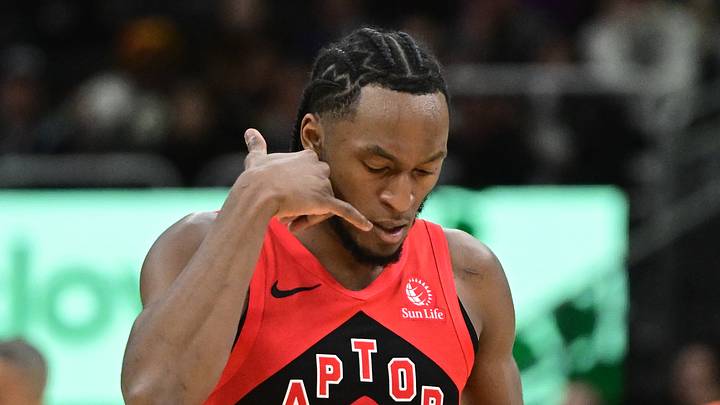
Quickley led the Raptors in 3-point attempts per game with 6.8 this past season. He made 37.4% of them. That number is very much in line with his career average, so the Raptors can expect him to shoot a similarly high percentage again in the 2026-27 season. It’s been five seasons since he’s shot below 37% from deep.
Walter is a less proven 3-point threat than Quickley. He shot just 34.9% on 3.6 attempts per game in his rookie season, but found his touch this year and emerged as the Raptors’ most efficient 3-point shooter (not counting Jamison Battle and A.J Lawson, who weren’t steady parts of the rotation). Walter finished the season shooting 40.9% on 3.7 attempts per game after a strong second half. He shot just 35% pre-All-Star break but 47.6% for the rest of the season.
Walter’s hot shooting didn’t hold up in the playoffs. He shot just 32.7% on 7.4 attempts per game. But in his defense, he was a second-year player in his first-ever NBA playoffs and had to fill a much bigger role than expected due to Quickley’s and Ingram’s injuries. Going into the season, no one would have guessed that Walter would average 32 minutes per game in a playoff series.
So, chances are pretty high that he will be a reliable 3-point threat for the full regular season after gaining confidence from his second pro season and having a full summer to continue to work on his shot. Continuing to make his shots is the easiest way for Walter to ensure that he has a long career with the Raptors.
 Add us as a preferred source on Google