

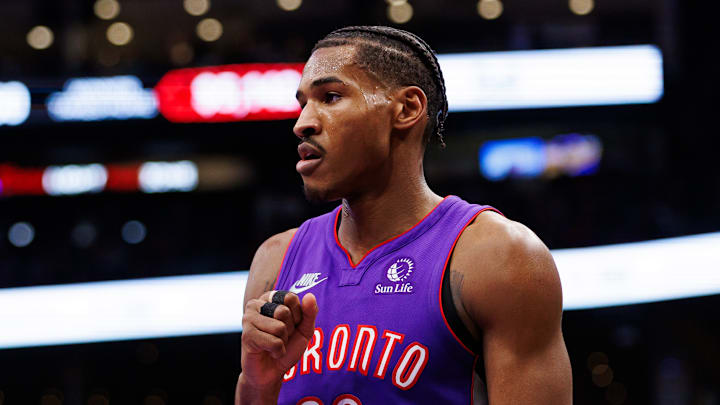
The Toronto Raptors were relatively quiet at the NBA Trade Deadline, avoiding a massive swing to keep their team together. The one significant move they made was to unload the contract of Ochai Agbaji, a trade that saved them some money -- and highlighted just how expensive this roster truly is.
The trade ended up as a three-team round robin deal, with Agbaji and a 2032 Raptors second-round pick -- and some cash -- going to the Brooklyn Nets. The Raptors took on Chris Paul's minimum contract and are expected not to retain him, and saved $7 million in tax money and getting them out of the luxury tax entirely.
Agbaji is a solid 3-and-D wing; he was a rotation player for a competitive Raptors team and at the nadir of his value. His shot abandoned him this year, but he hit 39.9 percent of his 3-point attempts last season, and was shooting 86.2 percent on free-throws this season. A bounce back was very possible.
Rather than keep him and ride the wave back up, the Raptors dumped him on the Nets. There likely would have been a competitive team interested in taking a flier on Agbaji, but the Raptors needed a deal where they were getting off of the majority of his contract to ensure they fully ducked the luxury tax.
Toronto is 30-22 and in 6th-place in the Eastern Conference, just one single game out of 4th place. They should be pushing the chips in for a run in the playoffs. Lacking a true superstar, however, they instead made a couple of minor moves, ensuring they wouldn't pay too much for a middling team.
That's the problem; this team was not worth pushing the chips in for. They certainly pursued other trades, but there was a massive barrier in the way: no one wanted the Raptors' players.
The Raptors should be terrified by the state of their roster
More specifically, no one wanted the Raptors' contracts. Agbaji was on an expiring deal, but the rest of their rotation are on lucrative, long-term contracts (with only a couple of exceptions). Jakob Poeltl would have taken multiple firsts to incentivize a team to take his contract on. Immanuel Quickley is underwater on his deal. RJ Barrett and Brandon Ingram are perhaps properly paid, but at large numbers.
Toronto has assembled an ensemble cast of good players on expensive deals; somewhere they need a contributor on a bargain deal. Their financial flexibility is extremely limited despite the low ceiling on this team. They need to shake things up, but can't afford to because their players are too expensive.
That is more a result of terrible team-building over the past few seasons and less a failure at this deadline. Toronto will have to dig itself out of the hole it has dug, and do so with one arm tied behind its back.
At least the organization gets to save some money this year by getting out of the luxury tax; that helps ownership in their quest for wealth. As for a move that changes this team's fate? Nowhere to be found.
 Add us as a preferred source on Google