

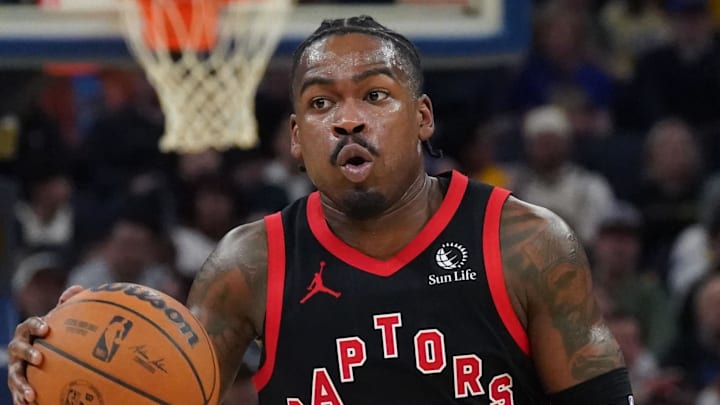
Jamal Shead has been nothing short of spectacular in his role this season. Head coach Darko Rajaković has not asked him to be the focal point of the offense. Instead, Shead’s job has been to make smart decisions, protect the ball, and compete relentlessly on defense.
For much of the season, he has thrived in that role. However, the last 10 games have seen Shead become far less effective, to the point that Toronto has played noticeably better with him off the floor. That naturally raises a fair question: have NBA defenses figured out Jamal Shead, or is this simply part of a young guard’s development curve?
Jamal Shead’s early-season impact
In Shead’s first 45 games, he averaged 7.2 points, 5.6 assists, and just 1.4 turnovers while shooting 36.5 percent from the field and 32.7 percent from three. Those numbers do not overwhelm at first glance, but his advanced metrics tell a more impressive story.
During that stretch, Shead led Toronto’s rotation players in net rating at +5.0. He posted an outstanding 4.08 assist-to-turnover ratio, stabilizing the second unit as the team’s only true point guard. He consistently made the correct reads and rarely forced passes.
Defensively, his impact was just as important. Shead ranks among league leaders in offensive fouls drawn. He hounds ball handlers, fights over screens, and plays with a physical edge that does not always show up in the box score.
The numbers behind the recent dip
Over the last 10 games, his production has slipped. Shead is averaging 5.2 points, 4.4 assists, and 1.6 turnovers while shooting 35.2 percent from the field and 28.6 percent from three. His assist-to-turnover ratio has fallen to 2.75, and his net rating during that stretch sits at -2.5.
The mistake-free style that defined his early success has been less consistent. He is turning the ball over more frequently and converting even fewer of his scoring opportunities.
Shead’s value is built heavily on his ability to control possessions and create opportunities for others. Even a small decline in that area has a large effect on his overall impact.
Are defenses adjusting?
Shead has clear limitations. He is undersized, lacks elite athleticism, and is not yet a consistent three-point shooter. It is fair to wonder whether defenses are now challenging him because of those limitations.
Teams appear more comfortable going under screens and daring Shead to score. When defenders do not feel pressure to chase over the top, they can stay attached to shooters and shrink passing lanes. That forces Shead into pull-up jumpers or contested finishes rather than allowing him to create for others.
Earlier in the season, Shead punished aggressive help by finding the right pass. Recently, opponents seem content to test him as a scorer instead of a passer.
This adjustment phase is not unusual for a young point guard. NBA defenses constantly evolve once they gather enough film. The challenge for Shead is learning how to effectively counter those adjustments.
What comes next?
For Shead, the path forward is clear. He does not need to become a high-volume scorer. He does need to become more confident as a pull-up shooter, improve his finishing, and consistently convert open opportunities when defenses go under screens. If he can punish those defensive choices, the passing lanes will reopen.
A 10-game dip does not erase a wildly successful first half of the season. It does, however, mark the beginning of the next developmental step. If Shead adjusts as quickly as he processed the game earlier this year, this stretch will further solidify his role in Toronto’s second-half push.
 Add us as a preferred source on Google