

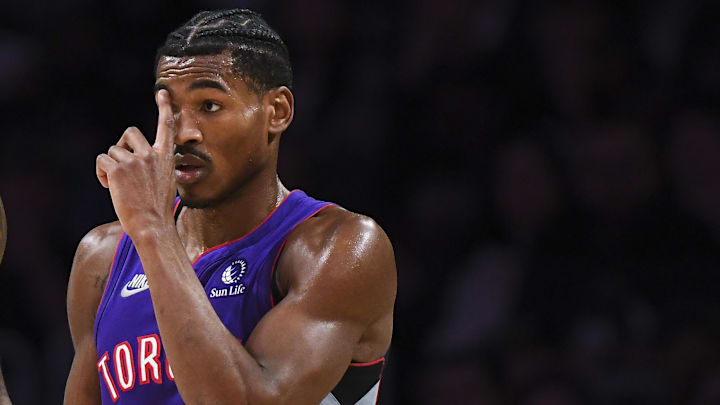
After a long period of figuring out exactly when the Raptors would trade Ochai Agbaji's expiring contract, they finally closed the deal yesterday, largely as a cost-cutting measure. Toronto acquired NBA legend Chris Paul in the transaction, but he is not expected to report. The 40-year-old all-time great is likely to be bought out sooner rather than later.
It also cost the Raptors a future second-round pick to dump Agbaji's $6.3 million contract to the Brooklyn Nets, clearly indicating how much his value has dipped across the trade landscape. Considering what the Raptors have on their books — much worse monetary agreements for guys like Jakob Poeltl and Immanuel Quickley — I think it’s clear that Toronto would have had to give up a handful of draft picks to convince a rival team to take them on.
While Agbaji's shine on the Raptors came crashing down in the most stunning way possible — going from the quintessential 3-and-D threat he looked like last season to a measly end-of-rotation option this year, I wasn't incredibly surprised he wasn't looked at as an alluring asset. But at just over $6 million in expiring salary, you're telling me the Raptors had to attach a pick (even if it was a second-rounder) to move on from him? That's quite bleak when considering the state of this Raptors roster.
It just seems so absurd to me, considering how long the Raptors have had to explore adequate trade options for Agbaji — going as far back as last year's deadline and this past summer. In fact, I bet that if Toronto shopped Agbaji around last February, they could have definitely gotten some second-round picks back, and if they really sold rival teams high on his value and impact — perhaps even a late first-rounder, if we're being honest. Mind you, this was a guy giving the Raptors averages of 10.4 points on 50 percent field goal shooting, 40 percent from three, 3.8 rebounds, and close to a steal (0.9) per game.
Raptors blew their chance to capitalize on Ochai Agbaji when he had value
Agbaji looked like someone you could trust to be a solid perimeter defender, someone who can cut to the basket, and hit the three-ball at an elite rate — what playoff team wouldn't want to have an archetype like that on their roster? The other chatter surrounding Agbaji was his impending need for an extension, that Toronto could've given him over the summer, but they ultimately chose to stay away from working out a new agreement.
In hindsight, that decision saved the Raptors another headache, as things could have been much messier if he was earning more than his $6 million price tag and they had to find a way to move him.
As much as Agbaji is at fault for experiencing a severe downturn in his on-court play, the majority of the blame still falls on the Raptors for failing to recognize when to maximize an asset at its peak value. If the Raptors had no plans to extend him anyway and were only seeing what he could contribute to Toronto's hopeful 2025-26 playoff push, that was a highly risky move, and it backfired. Agbaji was used in spurts this season, but he received far less than the 27.2 minutes he averaged last year. With new additions to the rotation, Toronto's front office should have known better than to expect Agbaji to replicate his previous success in a condensed sample.
Just an unfortunate outcome overall that could have been handled much more effectively on the Raptors' side.
 Add us as a preferred source on Google