

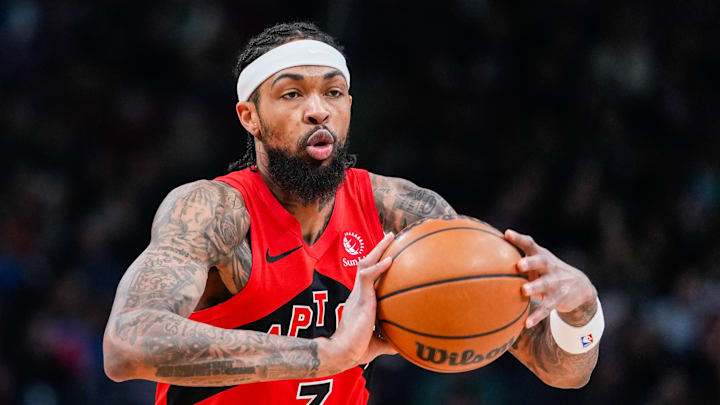
The Toronto Raptors have built something unique with their offense.
In past seasons, Toronto was criticized for not having a true lead scoring option. Brandon Ingram has helped address that issue, but he certainly hasn't done it on his own. Instead, Toronto leans into a pass-heavy system where the scoring burden is shared among a quartet of legitimate options.
Brandon Ingram, Scottie Barnes, RJ Barrett, and Immanuel Quickley all average at least 17.0 points or more per game. Toronto is the only team in the NBA with four players averaging that many points.
The overall team numbers are less impressive. Toronto ranks 23rd in points per game and 25th in three-point percentage, per Basketball-Reference. Still, this balanced approach has helped compensate for weaknesses and has been a driving force behind the Raptors’ success.
The Raptors are a pass-first team
Toronto’s offense is a slight enigma.
On one hand, it can look cramped due to a lack of floor spacers. On the other, the Raptors attempt to compensate for that limitation with constant ball movement. They rank ninth in the NBA in passes made per game, and third in both assists per game and assist-to-turnover ratio. All of those numbers point to a team that thrives on moving the ball.
Unsurprisingly, the head of the snake in this pass-first approach is Toronto’s trio of primary initiators: Immanuel Quickley, Scottie Barnes, and Jamal Shead. They lead the team in total passes and assists per game. Quickley, despite his reputation as a ball-stopper, ranks 13th in the league in total passes per game.
The Raptors also have the sixth-closest average field goal attempt in the NBA at just 13.6 feet from the basket. When a team lacks consistent three-point shooting, it must create space in other ways, and Toronto does so through passing. Crisp ball movement bends the defense and opens driving lanes in a way that can mimic the spacing created by elite perimeter shooting.
That space allows the Raptors to attack the paint and finish inside.
Will this approach be sustainable in the playoffs?
Every summer we hear the same phrase: playoff basketball is different.
Regular-season success does not always translate once whistles tighten and defenses become more physical. The 2014-2018 Raptors were a prime example, leaning heavily on isolation scoring from DeMar DeRozan and Kyle Lowry, only to see that approach stall when the game slowed down in the postseason.
So, will a balanced, pass-heavy offense be any more successful? Well, recent history offers mixed evidence.
Last season’s eventual champion, Oklahoma City, ranked bottom six in passes made per game. Their Finals opponent, the Indiana Pacers, ranked second. Indiana also featured a balanced scoring profile, with their top four scorers averaging between 15.6 and 20.2 points per game. Before that, you have to go back to 2022 to find a Finals team ranked that highly in passes made per game, when the champion Golden State Warriors ranked second.
There is no single offensive system for playoff success. Toronto’s current approach has some recent success, but it is not overwhelming. Some contenders thrive on movement and shared scoring. Some win by leaning into isolation and shot creation. The Raptors will have to prove that their balance can withstand postseason defenses and tighter officiating.
 Add us as a preferred source on Google