

The Toronto Raptors have always been a unique organization in how experimental they are with team building and coaching. When you look back at some of the biggest philosophies in the modern NBA, the Raptors were kind of a trendsetter with their Project 6-9 approach. While most teams haven’t taken things to the extreme Toronto did, every front office is searching for long, wiry wings and forwards with ball skills that they can slot up and down their lineup.
A philosophy that has really reemerged in recent years is having a ton of size in the frontcourt and hitting the offensive glass with that size super hard.
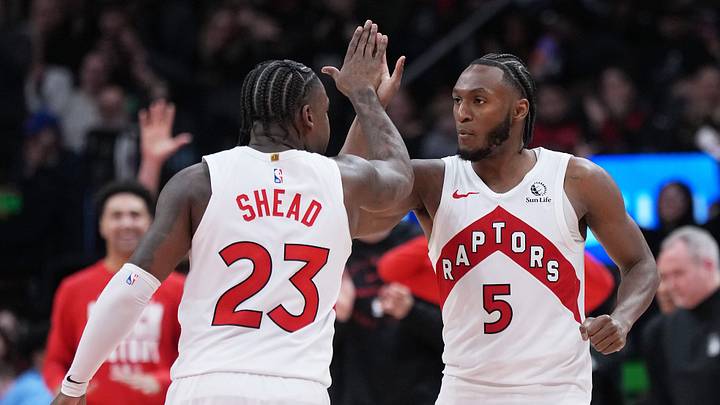
But what if the Raptors brought back another old NBA trend? What if they experimented with having two undersized guards in their starting backcourt in Jamal Shead and Immanuel Quickley? To start this new campaign, the IQ show hasn’t been very enjoyable, as with each passing game, it becomes clearer how in over his head he is at point guard, especially in the half-court.
In IQ’s first missed game of the season, Shead got the call-up and put up an impressive 16 assists to just one turnover. The combination of Shead’s natural playmaking talent and his defense, with IQ’s off-ball scoring, could give the Raptors backcourt everything it needs, so why not give it a try?
Jamal Shead and Immanuel Quickley could balance out the Raptors' backcourt
The Raptors' offense looked much better in the half-court against the Milwaukee Bucks than it had at any of the other three stops on their road trip. Shead’s ability to consistently get the team into their sets, or create a scoring chance for someone when a play broke down, was a breath of fresh air. What wasn’t fun to watch was Shead struggling to knock down jumpers or struggling to provide any type of scoring boost. That’s where IQ could add value next to Shead, as his off-the-ball scoring skill set would create a nice yin-and-yang vibe between the two guards.
We’ve also seen last season that Shead and IQ have good chemistry and play off of each other extremely well when sharing the backcourt. In 457 shared minutes last season, the Raptors had a net rating that was 4.1 points per 100 possessions better with both players on the court than with them off.
Now, I understand there will be obvious pushback about who moves to the bench and what a backcourt of Shead and Quickley would look like defensively with extended reps together, and that's fair.
When it comes to who moves to the bench, it’s important to be clear that I’m only saying to experiment with this while Kawhi Leonard is out, and in that case, Ja’Kobe Walter is the obvious name to move to the bench. He’s shooting 2-of-16 from three over his three two games and could use a role change for a bit to get back to his norm. On defense, this backcourt can get outmatched size-wise at times, and there’s no denying that. But with both players sharing the backcourt, they have to do less offensively, which in theory should give them more energy to play defense.
For Quick, his focus shifts from creating for others to his own scoring production. For Shead, his role becomes more about driving the offense and creating for his teammates instead of hunting his own shot.
I’m not saying it’s going to be perfect, but it’s still early enough in the season to be trying to get data on different lineups, and testing this backcourt out could be super beneficial. Not to mention, it also opens up a guard spot off the bench for Alijah Martin, who needs to be part of the rotation following the way he played against Milwaukee on Friday.
 Add us as a preferred source on Google