

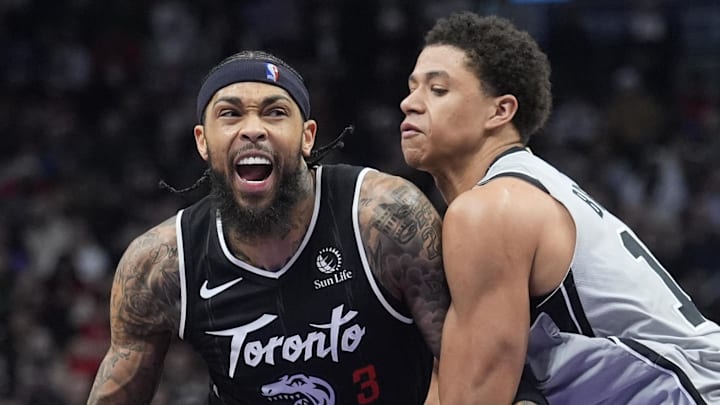
The Toronto Raptors are fighting in the midst of the Eastern Conference playoff race to secure their position and give them a chance in the postseason. That fight has unveiled their best lineup -- except their All-Star forward Brandon Ingram is holding them back.
An NBA basketball game is 48 minutes long, and it's not realistic for players to stay on the court for the entire game. Multiple lineup combinations are required, and even having an undeniable star at one position doesn't mean you don't need depth behind them to take the court when they sit. Winning basketball is more complicated than "these players are good together."
Yet at the end of the day, a team's fastball is the most important weapon for them to bring to the battle. Can a team put a group of players on the court that will overwhelm the opponent? Think of the dynasty Warriors and their "Death Lineup" putting Draymond Green at center and brining Andre Iguodala in off the bench. Teams were helpless to stop that group, and it led to multiple championships.
The Raptors have found a lineup that works
For the Raptors, they have figured out much of that combination for this season. Looking at the best combination of players for them to deploy, one trio stands out: Scottie Barnes, Immanuel Quickley and Jamal Shead.
The Quickley-Shead backcourt in particular has proven to be a potent combination, and Barnes is the team's best player with a bullet. His All-Defense versatility is the key to their defense, and when paired with Shead they have the kind of event-generating impact that changes games. Add in Quickley's shooting and playmaking and you get a potent trio.
Those three players have spent 230 minutes together (not counting low-leverage minutes like blowouts), per Databallr. In those minutes, the offense has scored an impressive 126.4 points per 100 possessions (about 10 points above league average) and the defense has been stout, leading to a dominant +16.1 net rating. Excellent.
Here is the problem. The natural next addition to such a lineup is the small forward, and the Raptors just so happen to have an All-Star small forward making $40 million per year. Add him into the mix, however, and everything changes.
Brandon Ingram is the problem
When Ingram joins Quickley, Shead and Barnes on the court, the group together drops to outscoring opponents by only 7.9 points per 100; good, not great. The offense stays stout, but the defense falls off of a cliff. Ingram's propensity for losing opposing players through inattentiveness or poor footwork plays right into that.
The flip side is thus revealed: if you look at our super threesome on the court specifically without Ingram, their impact shoots up to +30.8 points per 100, albeit in just 75 minutes. That trio is special, and when they cast off the lead anchor that is Brandon Ingram, they become elite.
To be fair to Ingram, he is a good player whose shot creation is valuable. He is overpaid at $40 million per year, but it wasn't insane that he received that contract.
On a team with real upside waiting to be fully unleashed, however, Ingram is standing firmly in the way. Whether that means continuing to work to find the right lineups to build around him, or whether that means looking for a new home this summer, it's a problem that head coach Darko Rajakovic has to solve.
Right now, Ingram is the problem. And the Raptors already know the solution.
 Add us as a preferred source on Google