

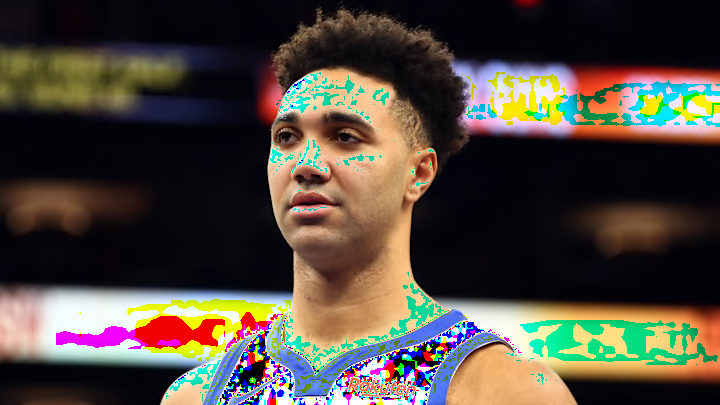
Toronto stayed relatively quiet at this year's trade deadline, with their most noteworthy acquisition being big-man Trayce Jackson-Davis from Golden State in exchange for a second-round pick. It is not a blockbuster move that will reshape the Raptors’ season, but it does offer potential upside at a minimal cost.
So what does this move actually mean for the Raptors?
Did the Raptors get better?
This is the first question I ask after any transaction. For Toronto, the answer is yes.
It is not a jump-up-and-down yes, but the team did improve. Many felt the Raptors’ biggest need was another big-body to help stabilize the rotation while Jakob Poeltl continues to recover from injury. Toronto addressed that need, and it did so as cheaply as possible, surrendering only a second-round pick.
Jackson-Davis will turn 26 at the end of the month and is in his third NBA season after being drafted 57th overall in the 2023 NBA Draft. He played a meaningful role for Golden State during his rookie season, but somewhat concerningly, his role and playing time have declined each year since.
This season, Jackson-Davis has averaged 4.2 points and 3.1 rebounds while playing just 11.4 minutes per game. Those numbers are modest, but his playstyle is a very good fit in Toronto. He does not space the floor, but he is efficient in transition, rebounds well in limited minutes, and is known as a positive locker-room presence. Those traits align well with Toronto’s system, which prioritizes pace, effort, and defensive versatility from its frontcourt players.
Was there another option?
Some fans would have preferred Toronto use more of its assets to pursue a more established big, with names like Anthony Davis or Domantas Sabonis often coming up in discussions. A swing that large would have been unrealistic and likely counterproductive, but there was a middle ground worth considering.
A move for a more established rotation big-man may have produced a larger short-term impact without dramatically increasing the cost. Jock Landale, for example, is averaging 11.3 points and 6.5 rebounds in 23.6 minutes per game and provides reliable floor spacing from the center position. Landale was included as a throw-in during a larger trade involving Jaren Jackson Jr., then later rerouted to Atlanta in a salary dump.
A player in that tier may have helped Toronto more immediately than Jackson-Davis. However, such a move likely would have required additional salary matching or assets, something the Raptors clearly wanted to avoid.
How should Raptors fans feel?
This move is not an A+, but it accomplishes exactly what Toronto set out to do. The front office addressed its biggest need at the smallest possible price. More importantly, it signals how the organization views its current timeline.
Toronto believes this team is ready to gain playoff experience, but it also understands that internal development remains the priority before committing major resources to roster upgrades. That is a smart long-term approach from the front office.
Overall, Raptors fans should view this move as a small win. Jackson-Davis may not dramatically alter the ceiling of this team, but he raises the floor, and he does so without compromising future flexibility. Sometimes, that is exactly the kind of move a developing team needs to make.
 Add us as a preferred source on Google