

Toronto's current March record stands at 1-3, falling relatively short of what fans hope to see during this final stretch before the playoffs. While it’s somewhat easier to accept these losses knowing they came against top-tier opponents — the Knicks, Timberwolves, and Rockets — the results still cast a worrying shadow over the Raptors' ability to compete with strong teams as the playoff race heats up. With so much at stake in this stretch, the upcoming games will be crucial for Toronto's postseason hopes.
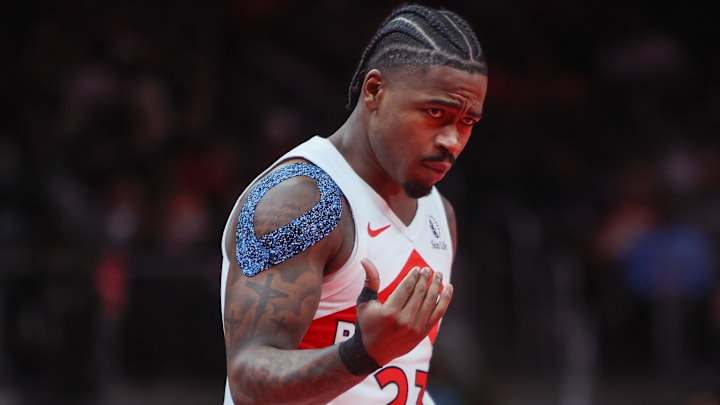
And while we’re on the topic of struggles and a troubling shadow emerging, the Raptors' resident gritty guard Jamal Shead has had an exceptionally difficult stretch lately.
Jamal Shead has earned a steady role on the team thanks to his strong work ethic, dedication to winning basketball, and relentless effort to establish himself as a vital part of the Raptors' current lineup. Last year, Shead and former Raptor Davion Mitchell essentially faced off in a battle to prove which stout guard could be Toronto’s better long-term option. Ultimately, it became clear that Shead had the support of the Raptors organization, as Mitchell was traded at that year's deadline.
Toronto showed a lot of faith in Jamal Shead, betting on him to become a key player. They kept their guard depth relatively thin before the season started and even after the trade deadline, taking a bold risk. This decision put Shead in a vital spot, making him the primary guard to step up when Immanuel Quickley is off the floor or sometimes sharing the court with him.
While Shead's shooting struggles have long been apparent to Raptors fans (even acknowledged by head coach Darko Rajakovic), this recent stretch might just be his worst in NBA basketball to date, all things considered.
Jamal Shead has been largely ineffective for the Raptors as of late
Over his last five games, Jamal Shead has honestly been abysmal.
He's averaging just 3.0 points on a true shooting percentage of only 31.6 percent (27.3% from the field and 14.3% from three), along with 2.0 rebounds and 2.8 assists. During this stretch, his turnovers sit at 1.8 per game, highlighting a troubling decline in ball security and passing vision. This increase in turnovers has undermined one of his key strengths, his impressive assist-to-turnover ratio. Frankly, with each poor performance, Jamal Shead is looking less and less like an NBA-caliber player, raising serious questions about his future.
In fact, my Raptors Rapture colleague Daniel O'Connor pointed out some time ago that NBA defenses might have figured out how to neutralize Jamal Shead.
While Shead brings many valuable intangibles and character traits that make him a key part of the Raptors, this situation more or less echoes what the team recently experienced with Gradey Dick. Despite Dick’s efforts to make an impact, his consistent underwhelming production put his role in the hot seat, leading to a temporary removal from the rotation. Now, it’s becoming obvious that a similar honest conversation and internal reflection are beginning to take shape for Jamal Shead as well.
Shead is already at a size disadvantage as an NBA guard at just 6-foot-1, and his offensive versatility leaves much to be desired. But when he struggles to make the right passes, is hindered by poor basketball IQ, and ghastly shooting efficiency (those numbers are way too striking to overlook, even by Shead's standards), it creates a difficult situation for the Raptors.
How do you even justify giving him any significant minutes based on this? Where is the upside?
With the playoffs nearly here and Shead struggling, there aren't many options to replace him in the lineup. The Raptors might have to ride it out and hope he can find his rhythm again soon. However, in the offseason, Toronto may need to consider other options at that position in case Jamal Shead quickly loses his grip as a key contributor. The Raptors’ overall need for proven depth across the roster is evident, and right now, Shead’s role is at the very top of that priority list.
 Add us as a preferred source on Google