

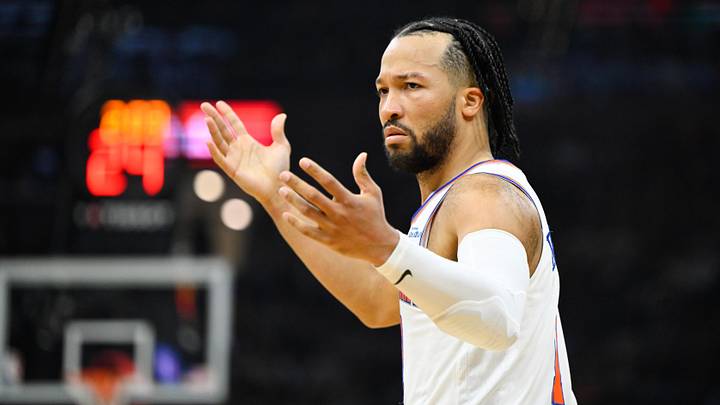
The New York Knicks have taken a commanding 3-0 lead over the Cleveland Cavaliers in the Eastern Conference Finals. The Cavs are at a rest disadvantage after playing two seven-game series against the Toronto Raptors and Detroit Pistons, but that’s not the only big difference between the two teams. Roster construction has a lot to do with it, according to Zach Lowe.
“The whole thing is humming,” Lowe said about the Knicks on the May 24 episode of The Zach Lowe Show, “but the construction of the team and just the wings versus the void of wings on the Cavs, I think, has just stood out so much in this series.”
The Knicks start three big wings—OG Anunoby, Mikal Bridges, and Josh Hart—next to Jalen Brunson, a small guard, and Karl-Anthony Towns, an often defensively-challenged big man. Their size, athleticism, defense, and 3-point shooting allow the Knicks to mask any deficits at the point guard and center spots. The Cavs, meanwhile, have two elite guards and two great bigs, but a glaring lack of highly impactful contributors on the wing.
New York is proving how important big, versatile two-way wings are, which is great news for a Toronto Raptors team with a thing for that exact archetype. But the Knicks would not be where they are without Brunson, who is averaging over 27 points per game in the playoffs, which is a strong reminder of one thing the Raptors lack compared to New York: an elite guard.
Size and versatility aren’t everything
The Raptors love big, versatile wings who can defend multiple positions and initiate offense. They did, after all, build a championship team around Kawhi Leonard.
Years later, they still relied on players of that archetype to carry the team. The Raptors’ three most productive players in the regular season were Brandon Ingram, RJ Barrett, and Scottie Barnes. All three of them are at least 6’6” and can fill different roles on offense. Barnes is also one of the most versatile defenders in the NBA and can guard any position.
Toronto needed that size and versatility on the wing and forward spots to make up for its lack of reliable center play and a tough blow to their playmaking when Immanuel Quickley went down. Barnes, Ingram, and Barrett all averaged at least 3.3 assists in the regular season, and Ingram and Ja’Kobe Walter were two of the Raptors’ most reliable 3-point shooters.
The Raptors may have the big, versatile wing/forward part of building a winning team down, but they have some serious deficiencies at the guard and big postions. Quickley has been fine for the Raptors, but he’s not nearly on the same level as Jalen Brunson, Shai Gilgeous-Alexander, or De’Aaron Fox, who all run the offense for some of the most successful two-way teams in the NBA.
If the Raptors want to take the next step offensively, they need better guard play, better perimeter scoring and offensive creation.
 Add us as a preferred source on Google