

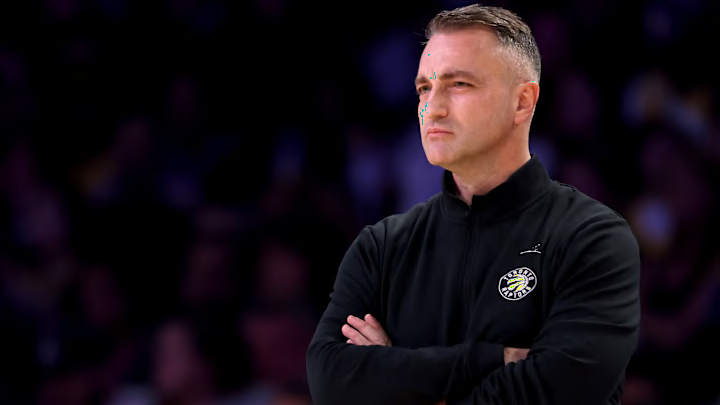
It's been tough to watch Toronto face a wave of injury adversity, with several players missing in action among both starters and reserves. But on the bright side, the Raptors have still managed to play winning basketball and are experimenting with the lineup options available to them in the meantime.
When everyone across the Raptors' roster is healthy, Toronto has mostly rolled out the usual starting five of Quickley, Barrett, Ingram, Barnes, and Poeltl. However, Barrett has missed a significant amount of time due to injury, so his spot has mostly gone to players like Ochai Agbaji and Ja'Kobe Walter, before he recently went down. Meanwhile, the ongoing Poeltl injury saga has forced the Raptors to pivot to guys like Collin Murray-Boyles, Sandro Mamukelashvili, slotting Scottie Barnes into the five-man role.
In this most recent two-game stretch between January 20 and 21, the Raptors have been starting Jamal Shead and Immanuel Quickley in the backcourt. Prior to this, the duo of Shead and IQ also started in another two-game span between January 11 and 12. In the collective four-game sample, the Raptors have gone 3-1. And I don't think it's a coincidence that, after being paired with a traditional point guard, Immanuel Quickley's just had a career-best performance against the Warriors.
Even before the limited starting sample of Shead and Quickley together, a positive trend has already become apparent. Raptors insider Michael Grange highlighted this in his post-game Kings piece for Sportsnet, noting: “In 262 minutes together before the Kings game, lineups featuring the two guards were +9.3 points per 100 possessions with a True Shooting percentage of 60.7 — significant improvements on the Raptors' overall +1.9 net rating and 57.2 per cent [sic] True Shooting.”
Immanuel Quickley shines in ball-handling tandem alongside Jamal Shead
In the Warriors game, the two guards combined for 50 points, 18 assists, three steals, and five turnovers. Against the Kings, they offered a more balanced attack with 33 points, 14 assists, 11 rebounds, four steals, and just three turnovers between them.
Raptors fans can attest to the lingering issue with Immanuel Quickley's effectiveness as a point guard, mainly because his offense-focused style isn't quite on par to that of the traditional floor general archetype like Jamal Shead. It's not that IQ can't handle the position, but it's clear that his offensive firepower can't be fully unleashed when he's also responsible for running the floor and setting up teammates.
Put Quickley alongside an archetype like Jamal Shead, and it allows IQ to space the floor better off the ball and focus on getting his best looks. This approach helps him avoid the trap of trying to force shots and fall into inefficient stretches. Especially when it's a consummate professional ike Jamal Shead out there, who’s been praised by his peers for bringing out and leading the best in his teammates — just ask Sandro Mamukelashvili.
Quickley's costly contract, as I’ve highlighted before, is mainly an oversight the front office might have to just take on the chin, but it's far from a dead end. The goal is to find ways to maximize his effectiveness and turn his current negative value into brilliance — likely the initial motivation all along. You can still start Quickley without issue, but instead of flipping his contract just for the sake of it, the Raptors are learning that pairing him with another ball handler is the smarter play at hand.
The focus should be on either embracing the Shead-IQ starting duo long-term or using assets to bring in a different running mate for IQ, all while letting Shead thrive with the revitalized bench. But maybe the new question in the aftermath is where RJ Barrett fits into all of this? However, he could be the piece they use to make a deal happen, or they might pivot to using Barrett to lead the second unit.
We'll just have to see how things unfold once this Raptors core is fully healthy and checking in on the developing storylines over the next few weeks.
 Add us as a preferred source on Google